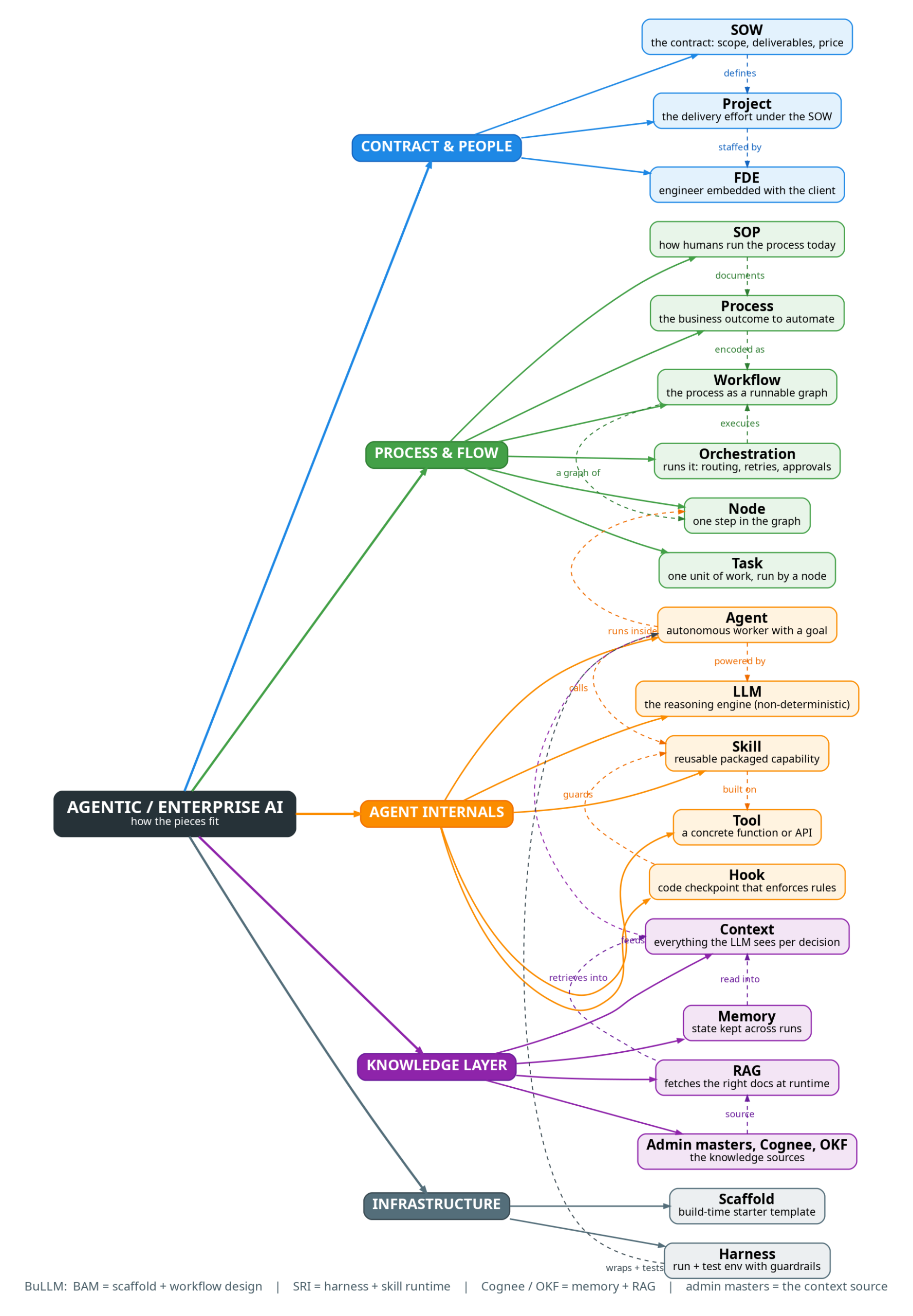
An enterprise AI project involves more than a model and a prompt. A contract defines the work; people map the business process; software runs it; and controls help make the result reliable. This glossary is a working model for discussing those parts, not an industry standard or a strict technical dependency tree.
Start with the business work
SOW (Statement of Work) is the contract that sets scope, deliverables, timelines and price. A project is the delivery effort under it, with a team, milestones and a budget. An FDE (Forward Deployed Engineer) works with the client to turn the SOW into a functioning system.
The FDE first studies the process, the end-to-end business outcome to improve. For example, an enquiry-to-quote process starts with a customer request and ends with a usable quotation. An SOP (Standard Operating Procedure) records how people carry out that process today. It helps reveal the decisions, exceptions and approvals the new system must handle.
Turn the process into a running flow
A workflow encodes the process as steps, branches, approvals and hand-offs. Each node is one step in that graph: it might invoke an agent, call a tool, test a condition or ask a person to approve something. A task is a unit of work assigned at runtime, such as costing one BOM line. These are related concepts, not necessarily a fixed one-task-per-node rule.
Orchestration runs the workflow. It decides the order of steps, routes work to the right agent or person, tracks state, and handles retries and approvals. A workflow describes the path; orchestration moves work along it.
Look inside the agent
An agent is an LLM-driven worker with a goal, access to tools and some autonomy within a workflow. The LLM (Large Language Model) reads the information available for a decision and proposes a next step. It is not the whole system: its output can vary, so checks around it matter.
A skill is a reusable packaged capability, such as normalizing a BOM or fetching a supplier price. A tool is a specific callable function or API, such as search, a calculator or a CRM lookup. An agent may use a skill that calls several tools, or call an allowed tool directly.
A hook is a programmed checkpoint before or after a run, such as a permissions check, output validation or logging. Unlike a reminder inside a prompt, a hook can enforce a rule in code.
Give it the right knowledge
Context is the information the LLM sees for a particular decision: instructions, relevant documents, memory and tool results. Context is limited, so choosing what belongs in it matters.
Memory is information retained across runs, such as client facts, preferences and prior decisions. It is useful only when the right parts are brought back into context.
RAG (Retrieval-Augmented Generation) retrieves relevant documents or records when they are needed and places the useful parts into context. A company can use RAG to draw on governed sources rather than trying to put every document in every prompt. Retrieval does not make a source accurate by itself; source ownership, freshness and access still need managing.
Build and run the system
A scaffold is a build-time starter structure: repository layout, configurations, prompt templates and schemas. A harness is the runtime and testing wrapper around agents and skills. It manages execution, tool access, hooks, guardrails, logging and evaluation.
One way to picture the whole system: the SOW defines a project; the FDE learns from the SOP and maps the process; a workflow breaks the work into nodes; orchestration runs them; agents use LLMs, skills and tools; hooks and the harness check execution; memory and retrieval supply context. Results then go back to the project team to test against the SOW.
How this maps to BuLLM
In the glossary's working model, BAM supports scaffolding and workflow design; SRI covers the execution harness and skill runtime. Cognee and OKF support the memory and retrieval layer. The Organization, Rules, Agents, Skills and Filetype admin masters are governed context sources that agents can draw from when relevant. These are product-specific mappings, not universal definitions of the terms.